
Let me be the one
To do what is done –
My share at least lest I be empty-idle.
Keep off each other and keep each other off.
You see the beauty of my proposal is
It needn’t wait on general revolution.
I bid you to a one-man revolution—
The only revolution that is coming.
Robert Frost, ‘Build Soil’ (1932).
Robert Frost’s 1932 poem ‘Build Soil’ opens with a discourse between Meliboeus and Tityrus, two characters from the opening of Virgil’s Eclogues. They each share contrasting fortunes as farmers in the original poem, which Frost uses to echo the Great Depression that was then devastating American agriculture. While Meliboeus laments his own situation, forced to buy a nearly-barren mountain farm, he urges the better-off Tityrus to use his literary gifts to help farmers and workers: ‘The Muse takes care of you. You live by writing / Your poems on a farm and call that farming’.
After considering the available political options, Tityrus advises his friend to ‘[s]teal away and stay away. Don’t join too many gangs. Join few if any’, since ‘going home / From company means coming to our senses’. He reminds him of a refrain he had written many years before: ‘Let me be the one / To do what is done – / My share at least lest I be empty-idle. / Keep off each other and keep each other off. / You see the beauty of my proposal is / It needn’t wait on general revolution. / I bid you to a one-man revolution – / The only revolution that is coming’.
The American poet and essayist Wendell Berry, another farmer-writer, would have agreed with the advice offered by Tityrus. Berry, who has just died at the age of 92, spent the better part of seventy years writing about, and campaigning for, pastoral life from his farm in rural Kentucky. His views were shaped above all by his opposition to the forces of capitalism and officialdom, which he witnessed over his lifetime devastate rural community and environment in his home state and further afield. The writer Paul Kingsnorth has neatly encapsulated Berry’s philosophy: ‘Slow down. Pay attention. Do good work. Love your neighbours. Love your place. Stay in your place. Settle for less, enjoy it more’.
Yet Berry’s seemingly-simple opinions saw him inveigh against right and left alike. On the one hand, he criticised the rampant greed of free-market capitalism and Western society’s dependence on multi-national corporations; on the other, he condemned rootless individualism and the dominance of urban culture. As a child of the Cold War, he also critiqued capitalism and communism for their similar devotion to coercive government, albeit for different ends. As a result, Berry proved a difficult figure for either the conservative or the progressive movements to adopt fully; often gaining positive notices by each side for his contrasting support for the traditional way of life and environmentalism, but remaining a figure apart. I would argue, however, that Berry’s stance can be identified as anarchistic in both its principles and its practice.
Although Wendell Berry never called himself an anarchist, from its earliest days, his politics have evinced a profound opposition to government and its corporate proxies. He argued that a nation’s political leadership and its market possess the same goals of dominance and exploitation, which has led to such close links between each. Indeed, he identified each as representing an anti-human force in society, lacking, as they do, what he terms ‘a realisation of the shortness and smallness of human lives’. In his critique, Berry focuses on the concept of ‘limitlessness’ as the disease afflicting each; i.e. a Faustian bargain in which science and technology have been used to exploit people and resources in ways that exceed the limits set by Nature.

The roots of Berry’s philosophy were grounded in a number of traditions. Firstly, his back-to-the-land pastoralism derived in large part from the nineteenth-century American Transcendentalism of Ralph Waldo Emerson and Henry David Thoreau, who sought a return to simple agrarianism and self-help. Secondly, the moral imperatives in his worldview are founded upon the Christian anarchism of Leo Tolstoy, Simone Weil and Dorothy Day. But, most immediately, his thought and writing were influenced by the New Left of the 1960s, in which he was involved as an activist, fighting for civil rights, social justice and environmental protection. Indeed, Berry remained active in his protest against American militarism, environmental despoilation, and the use of fossil fuels and nuclear power.
To Wendell Berry, the moral and the material were one. He identified himself as an agrarian, a pacifist and a Christian. While his work possesses a Christian inflection, however, it is one expressed in ways that are primarily ecumenical and spiritual. He has written that ‘farming is the proper use and care of an immeasurable gift’ and ‘the shortest away to understand this […] is the religious way’. Transcending a merely biological view of Nature, he urged us to adapt a broader sense of reverence and gratitude for its gifts: ‘We must learn to acknowledge that the creation is full of mystery we will never entirely understand. We must abandon arrogance and stand in awe. We must recover the sense of the majesty of creation, and the ability to be worshipful in its presence’.
Fired by this moral imperative, Berry’s opposition to government and capitalism is founded upon their mutual capacity for exceeding the bounds of the human and the natural world alike. Facilitated by advances in science and technology, the market has everywhere imagined limitless resources and unrestricted potential. In Berry’s view, this means pursuing the infinite, while disregarding the eternal. Consumerism and free-market economics have led to initiative and investment being lost by the locality in favour of the national and the global. Moreover, governments have increasingly used corporate proxies to provide education, housing and healthcare, among other resources – all areas of responsibility that were once the purview of the family or the community.
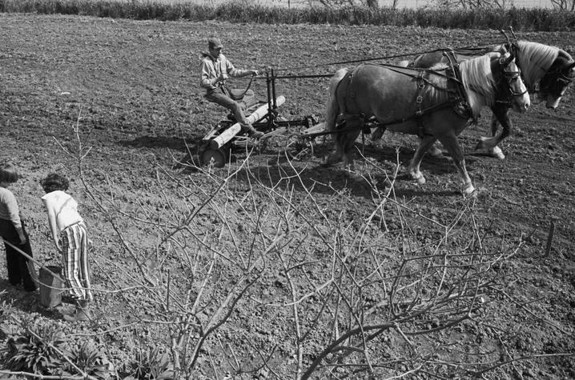
Yet, while Wendell Berry was accused of being nostalgic for a lost pre-capitalist past, he was more truly inspired with a passion for forging a post-capitalist future. His ideal was a peaceful, prosperous community dwelling on a healthy, self-renewing earth. Nor is his localism merely parochial: he understands the interconnectedness of social as well as ecological systems. Whether it is Kansas and Kentucky or Kenya and Kiribati, Berry argues that the same principle underpins economic and environmental destruction globally. He was keen to practice what he preached, too, using horses since the 1960s to work his farm, instead of machinery, and establishing a local cooperative to help farmers in his home state.
Of course, it is important to highlight Berry’s anarchistic conflict with the forces of government and capital. But one should also be mindful of his points of divergence with traditional anarchism. Unlike many of the guiding trends of anarchist activism since the 1960s, Berry forged a form of anarchism that rejected the urban for the rural, and a passionate, youth-oriented approach for a more philosophical, mature one. This is not to say that he rejected activism, since he remained a leading member of numerous protest movements throughout his career. But he seemed to fear that louder voices can drown out quieter opinions in any large-scale political movement.
For instance, while the environmental movement has concentrated a vast amount of its attention upon seeking a solution to climate change, the equally-important issue to farmers of global topsoil erosion has often gone unspoken. Berry’s approach was complicated, too, by his wariness of many of the defining features of twenty-first-century society. He outlined his opposition not only to the dominance of technology in our lives, but also to the influence of consumerism, individualism and urbanism. Nor should we avoid examining the nuances in his opinions. On the one hand, he expressed his support for gay marriage, yet, on the other, he remained deeply uncomfortable with the concept of abortion. Indeed, he expressed his unease with the consequences of the Sexual Revolution, suggesting that modern sexuality is effectively industrial in its quest for seemingly-endless partners and limitless pleasure.
In the history of anarchism, there has often been a tension between urban and rural. Since industrialisation effectively powered the rise of anarchism as a political creed in the nineteenth century, there has been a tendency for its proponents to focus on urban focal points, such as the Paris Commune. Yet, in the twentieth century, Nestor Makhno’s Ukrainian revolution was primarily a rural anarchistic movement, while Spain’s rural peasantry played a major role in the Republican side in the Spanish Civil War. But contemporary anarchism has arguably tended to concentrate on being a youth-oriented, urban-centred movement. In this context, Wendell Berry’s timeless, pastoral approach to anarchism offers a serene and mindful alternative.
Most importantly, Wendell Berry was an anarchist who was against revolution, at least in its traditional sense. He explained his position: ‘[T]he first temptation to avoid is the call for some sort of revolution. To imagine that destructive power might be made harmless by gathering enough power to destroy is […] perfectly futile. […] Arrogance cannot be cured by greater arrogance, or ignorance by greater ignorance’. But, calling to mind Robert Frost’s ‘one-man revolution’, he suggests that ‘the first fact of hope’ is that ‘we can change ourselves’: ‘We […] can remove our minds from the corporate ignorance and arrogance that is leading the world to destruction; we can honestly confront our ignorance and our need; we can take guidance from the knowledge we most authentically possess, from experience, from tradition, and from the inward promptings of affection, conscience, decency, compassion, even inspiration’.

Berry’s wariness of political revolution was emblematic of his pastoral-minded thinking, since agriculture is often a slow process that must assume the pace of Nature. The violent upheaval of an overnight coup – however benevolent its aims – was completely anathema to his organic vision of the world. His circumspection, however, extended to large-scale political movements, which he often perceived as involving an unhelpful component of group-think that negates individual responsibility. Again, this makes him a difficult figure to fit into traditional anarchism, which has often been predicated upon the cooperation of international networks. All of this can make Berry seem, to some, to have been a crank and a naysayer. But his criticisms and renouncement of modernity were all guided by a vision of recovering a condition we have lost over the past two centuries with the rise of industrialisation and the nation state.
Anarchists are often accused of being utopians, but Berry was wholly pragmatic, being literally down to earth, in his proposals. He suggested that what he stood for is what he stood on. Of course, this seems to conflict with Pierre-Joseph Proudhon’s famous injunction that ‘property is theft’. But Berry’s philosophy centred on the concept of stewardship, rather than ownership. In other words, he believed that we should invest our economic and spiritual resources in a place and in its people. Aware of the smallness and fragility of human life, he concentrates on what the individual and a local community can achieve through a one-person revolution. Berry invites us not to think on a vast, heroic scale, but on making small, incremental changes to our own lives that can provide the seeds of societal change in the generations to come.
Inspired by the Christian concept of salvation, Wendell Berry’s vision of a one-person revolution was centred, firstly, on the individual and, secondly, on their relationship to their community. Like the Transcendentalists, he believed that Nature provides humanity’s best teacher. But the ecological and economic redemption he seeks for the world can only come about through defeating the combined forces of nation state and market. These he blamed for using science and technology to exploit the resources of the earth and the human spirit alike in a boundless quest for ever-greater production and consumption. To him, the only reasonable response is the adoption of a quiet anarchism that seeks to challenge their power through harnessing individual willpower to local cooperation. But this is anarchism that does not shout loudly and respond rashly, but one that listens closely and takes measured, meaningful action.
In his 1988 essay, ‘The work of local culture’, Wendell Berry spoke about regularly walking past an old galvanized bucket on his farm. Every time he does, he looks in and, inside, discovers a minor miracle occurring: the elements and old leaves and dirt and dead insects and bird and rodent droppings have combined together to create soil. In the same fashion, Berry urges us to assume the pace of Nature, quietly cultivating the means for slow change using the eclectic material around us. Through evolution, rather than revolution, he suggested that we can create the ground for lasting economic and environmental change in ourselves and in our communities. In a world that can only be redeemed by quiet effort, Wendell Berry’s advice to us is simple, whether we live in the city or the country: dig down, lay roots, build soil.